The Simple 6-Step Process for Estimating Rehab Cost
September 23, 2020
1. Understand your buyer and the neighborhood.
Before you start calculating how much it will cost to rehab the property, you need to understand what the final product will look like. There are high-end remodels that take months, and there are quick flips that take just days. Understanding the level of finishing to which your buyer plans to rehab the property is imperative. Also, looking at the neighborhood around the property will give you a good indication of how far the rehab will need to go.
Typically, most investors do not want to go too far above and beyond the level of other properties in the neighborhood. Therefore, if the home is in a working class neighborhood with mostly working class rentals, you don’t need to spend hundreds of thousands on a rehab.
2. Tour the property thoroughly.
Next, with a good understanding of how you want the finished product to look, walk through the property very slowly. Take a lot of photos or record a video on your cell phone, so you can easily recall the condition later (trust me, you won’t remember it all). Furthermore, photos will help you sell the property later to the cash buyer.
If the seller is home, be sure to let them know you will be taking pictures, that they’re for analysis, and that you won’t be making the photos public. Don’t make them feel like you are invading their privacy.
3. Write down the problems in each part of the property.
While you are still on-site at the property, go room by room and write down its condition, as well as any needed repairs that you notice. For example, if you walk into the living room and see carpet that looks and smells like dog urine, write down “replace carpet in living room.” Also, write down a quick estimate of the size of the room. (It doesn’t need to be exact; just make your best guess.) Be sure to take a look at the exterior of the home, as well, and pay attention to any big issues, such as the condition of the roof, siding, and any outbuildings.
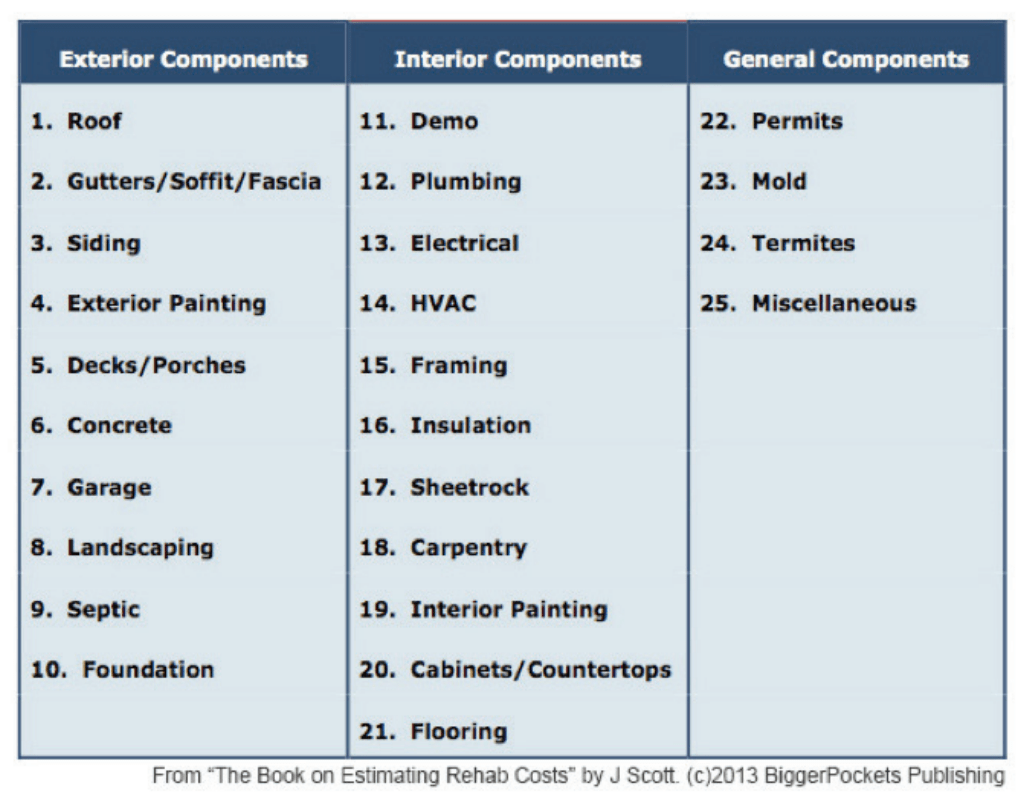
4. Condense your list into one of 25 categories.
Next, you’ll want take your comprehensive list of repairs and classify each one into one of the following 25 categories. For example, if the living room needs carpet, the bedrooms need carpet, and the kitchen needs vinyl, group all of them together and include them under “flooring.”
5. Determine a rehab price for each category.
Once you have your 25 categories spelled out, it’s time for the most difficult part: estimating the rehab amount for each category. However, once everything has been broken down into these categories, calculating an accurate estimate is much easier, as opposed to looking at the entire project.
Let’s return to the example of the flooring estimate. We may determine we’ll need approximately 1,000 square feet of carpet and another 500 square feet of vinyl. With that information, we can call up a local flooring or big-box store and ask what they charge for the flooring we need.
Speaking of big-box stores—I recommend spending a lot of time in them at the beginning. Learn how much material costs for the most common repairs, such as flooring, paint, cabinets, counters, appliances, etc. To get a really rough estimate on how much those items might cost in labor, double the price of the materials. Again, this provides just a rough estimate, but I find it to be fairly accurate. Additionally, you can go online and search sites such as Craigslist to see how much contractors are asking for certain jobs, such as replacing carpet or painting.
Related: Rehabbers Beware: 5 Big Issues Distressed Properties Hide (& How to Detect Them)
6. When in doubt, ask for help.
Don’t be afraid to ask for help. You can do this in a few different ways:
- Visit the BiggerPockets Forums and ask people there what they are paying. This is an incredibly useful tool, because you are able to get an inside look at what your potential cash buyers are spending.
- Ask a local contractor for help. Although you may need to pay them for their time, the cost of an hour or two consulting with this professional at the house would be an investment that would help you for years to come. Many wholesalers actually include a detailed, line-by-line bid from a licensed contractor with their presentation to a cash buyer, and I highly recommend doing that. The contractor will likely offer the bid for free, because there is a good chance the cash buyer will end up using them on the job, and you will not have to do the work of estimating the project.
- Ask a local real estate investor or another wholesaler to come with you. Getting really good at estimating rehab costs quickly is an important skill to have, so consider working on your first deal or two with someone who has been around the block and can share their knowledge.
Source: [ This article is an excerpt from Brandon Turner’s The Book on Investing in Real Estate With No (and Low) Money Down. ]